



Articles for your health.

NOURISH
Eat like an Olympian or Paralympian

Marie Christine Leisz, DO
Posted August 8, 2016
Watching world-class athletes compete at the Olympics or the Paralympics is inspiring. It may even spur some of us to kick our own training into a higher gear.
In addition to training, high-caliber athletes focus on eating. That means eating the right kind of foods—either high energy or high carbohydrates—to help them reach their Olympic goals. Swimmer Michael Phelps, for example, may eat nearly 8,000 calories on competition days. We should not follow his food habits unless we're also willing to train like an Olympic swimmer.
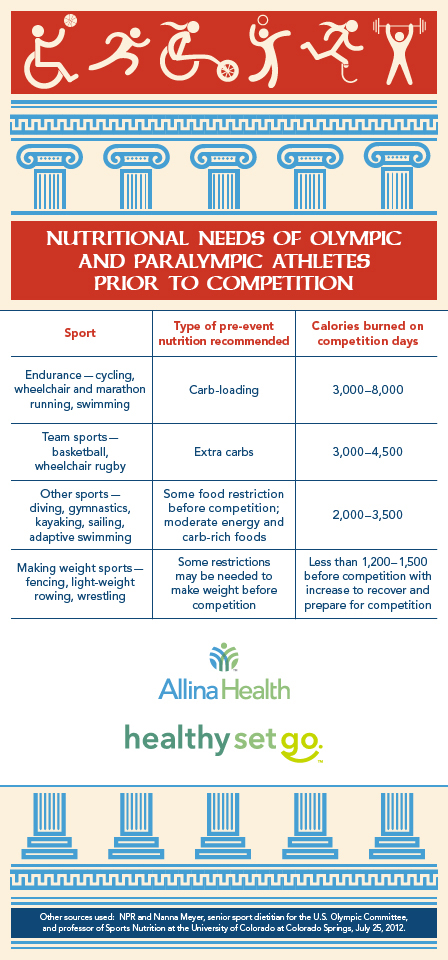
Here's a quick guide to the kinds of foods that Olympic and Paralympic athletes typically eat to prepare for their events, and how many calories they can burn on competition day.
[Click on infographic to view larger.]
View text in alternative format.
Infographic heading: Nutritional needs of Olympic and Paralympic athletes prior to competition
|
Sport |
Type of pre-event nutrition recommended |
Calories burned on competition days |
|---|---|---|
|
Endurance – cycling, wheelchair and marathon running, swimming |
Carb loading |
3,000-8,000 |
|
Team sports – basketball, wheelchair rugby |
Extra carbs |
3,000-4,500 |
|
Other sports – diving, gymnastics, kayaking, sailing, adaptive swimming |
Some food restriction before competition; moderate energy and carb rich foods |
2,000-3,500 |
|
Making weight sports – fencing, light-weight rowing, wrestling |
Some restrictions may be needed to make weight before competition |
Less than 1,200 – 1,500 before competition with increase to recover and prepare for competition |
Other sources used: NPR and Nanna Meyer, senior sport dietitian for the U.S. Olympic Committee, and professor of Sports Nutrition at the University of Colorado at Colorado Springs, July 25, 2012.
WHAT YOU CAN DO
-
Endurance Sports Injury Clinic
Make an appointment -
Help younger kids find balance
Learn more -
Adaptive sports and recreation
Participate in a program
Share this article
MORE ARTICLES LIKE THIS


EMPOWER YOURSELF
Get fun, inspiring, provider-reviewed articles sent to your inbox.
Sign up for our email newsletter