Allina Health esketamine treatment offers new hope for severe depression
“I do believe that our brain can be rewired,” said Marie, a patient who received care at Allina Health Mental Health – United Clinic. “We can just become so off that we can’t re-fire correctly despite our efforts to try. Ketamine allows your body to fire back in a healthier way, instead of keeping you in the trap you’re in.”
Deep despair
Marie has battled breast cancer, navigated the 2021 death of “the love of her life” and the loss of her mother when Marie was just 21 years old.
“My mom died at age 46. She died of breast cancer,” said Marie. “I’m 57. So, every year past 46, I get a new lease on life.”
Despite decades of therapy and a regimen of antidepressants, Marie said she reached a period of hopelessness she could not shake to the point of suicidal thoughts. “I couldn’t get anything to work. I was reading books. I was doing meditation,” said Marie. “I did therapy twice weekly, outpatient depression programs, peer group therapy, ECT (electroconvulsive therapy) and I tried multiple medication changes. I wanted a fix. Nobody could fix me.”
When her care team suggested Spravato®, she had reservations, but she also felt she was running out of options.
Trying something different
Spravato is the brand name of a nasal spray that contains the drug called esketamine. Ketamine is an anesthetic medication. This family of drugs made headlines in 2023 following the death of famed actor Matthew Perry, who played Chandler on the hit ‘90s show “Friends.” However, there is a distinct difference between the use of these drugs in a healthcare setting versus outside the supervision of a doctor.
“Esketamine is delivered intranasally. It is a prescribed treatment, and it has to be administered in a healthcare setting. Patients can’t just pick this up at their local pharmacy,” said Ryan Coon, MD, an adult psychiatrist with Allina Health at the United Clinic.
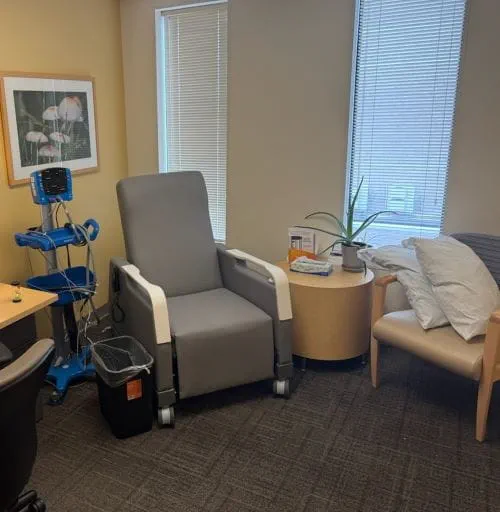
Like Marie, many patients referred for esketamine have not responded adequately to antidepressants or other forms of psychotherapy. Candidates undergo a thorough screening process and consultation visit with a psychiatrist prior to starting treatments. This includes a review of their depression history, medication trials, pregnancy status, blood pressure control, history of aneurysm and heart disease. In addition, clinicians obtain toxicology testing to ensure people are abstaining from substances. It's important to identify and treat comorbid chemical dependency prior to starting a Spravato treatment series.
Patients are not allowed to drive on treatment days, so they need to designate a driver to get them to and from the appointment. Marie’s sister accompanied her to the first appointment in October 2024.
“I was terrified,” shared Marie. “I didn’t know how I would react.”
Treatment appointments are a minimum of two hours. Patients have their vitals taken and meet with a psychiatrist before treatment begins. A nurse monitors patients as they take esketamine and continues to monitor their vital signs throughout treatment.
“The nurses couldn’t have been more pleasant,” recalled Marie. “They played the CD the love of my life made for me, and they listened to me.”
An out-of-body experience is how Marie explained the way she felt as the esketamine took effect.
“Most often, patients rest during the esketamine treatment. Some may experience some perceptual changes or sensory changes,” explained Dr. Coon. “Memories or a dream state can also come about.”
Patients generally return to a normal level of awareness and are steady on their feet by the end of the two hours, according to Dr. Coon, although it can take longer. For Marie, the change in her mental state came quickly.
The results
“I almost immediately felt better. My low was so low that anything was better than where I was, but I really did move the needle very, very fast,” said Marie. “I felt different. My sister said I was different.”
Esketamine patients typically receive treatment twice a week for four weeks, followed by weekly treatments for the next four weeks. These treatments are in addition to continued use of antidepressants. Dr. Coon likens it to the esketamine pushing patients out of the darkest parts of depression and the antidepressants helping them maintain a healthier mental state.
“As people become more informed about different mental health treatments, they’re asking more questions, whether it’s about Spravato or transcranial magnetic stimulation (TMS), we want them to know there is hope,” added Dr. Coon.
Today, Marie, who began working for Allina Health a few months after beginning treatment, describes herself as stable. She no longer has suicidal thoughts. The treatment did not erase the difficulty of her experiences, but it gave her the boost needed to continue working toward healing.
Because patients receiving esketamine often have severe, treatment-resistant depression, Dr. Coon said he considers it a success when a patient can go a year without needing to return for this level of intervention.
“I believe I am the case of someone who survived because of esketamine,” added Marie. “If you have treatment-resistant depression, I think it’s a great option.”

Allina Health's esketamine provider group: Emmett Chappelle, MD, left; Salwa Nubani, DO, center and Ryan Coon, MD.
Share this article


