
Call 612-863-3732612-863-3732
Givens Brain Tumor Center
913 E 26th St
Abbott Northwestern Hospital
Piper Bldg, Suite 304
Minneapolis, MN 55407
Givens Brain Tumor Center
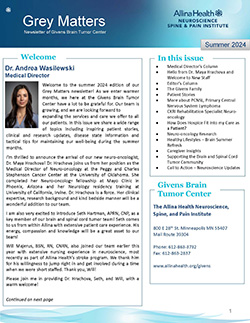
At the Givens Brain Tumor Center, we believe each patient deserves excellence in comprehensive care, including cutting-edge technology from a compassionate staff, in an environment focused on their unique needs. Our experts collaborate to provide comprehensive treatment that address each patient’s mind, body and spirit.
Our mission is to provide world-class coordinated, whole person care for patients with brain cancer
Features of the Center include:
- Coordinated, whole-person care, including a proactive relationship with patients and their care circle, facilitated by virtual and home visits
- Brain tumor support groups and connections into community resources
- Leading-edge diagnostics and clinical research
- A full range of advanced treatment options for adults with brain tumors, including chemotherapy, radiotherapy/radiosurgery, and innovative brain tumor clinical trials
- Supportive care from complementary Allina Health services, including Allina Health Cancer Institute, Courage Kenny Rehabilitation Institute and Penny George™ Institute for Health and Healing
Support group information
Brain and Spinal Cord Tumor Support Group
Temozolomide education for patients (audio)
Patient stories: Kathy
Nelli Designs is a pet memorial candle business and was founded after the death of our dog, Maggie. Post-tumor, I wasn't strong enough to stand and pour, and I missed it because, for me, to be in the candle studio pouring, it's my zen moment. My name is Kathy Kuhl, and I'm a patient at the Gibbons Brain Tumor Center.
Around 2011 or '12, my doctors said we found what looks like a cancer tumor inside your spinal cord. I was afraid of dying. I was afraid of being paralyzed. When I woke up from surgery, I couldn't move or feel. I can't feel my dog's head in my lap. I struggled to reconnect with a body that didn't feel like mine anymore.
Depending on where a tumor is located or where the surgery or treatment occurs, patients may have symptoms, and those symptoms may never quite return to their pre-tumor baseline. Many patients, like Kathy, may have successfully gone through their treatment, but have residual deficits based on where the tumor was located.
I didn't know how to deal with that. That was a big reason I needed to speak with a mental health professional about so how do I cope?
All right. Well, welcome, everyone to today's Survivorship Clinic.
Here at the Givens Brain Tumor Center and with the Hedberg Survivorship Program, it's a one-stop shop. You have one appointment and you meet multiple doctors and multiple different providers. We're talking about Kathy today, and at least during my visit, her imaging was all very reassuring. So no evidence of tumor recurrence today.
I am really the type of neuro-oncologist that doesn't just treat tumors. I really believe in treating patients. It's about a four-hour day, and it's great. First you meet with oncology, and you do speak with someone from mental health and check in with them on how you're doing and how is everything feeling.
It was really important for me to create a program where we can help patients get the most function, the best quality of life. I think that's the highest level of patient care, and our patients really deserve that.
And they put me back together somehow. That is what the Survivorship Program does, is help you feel like a whole person again.
[MUSIC PLAYING]
Related resources