From life support to stroke warrior: Andover woman shares her journey of recovery
"That's stuff that you only see in the movies,” Mindy said. “You know, that's not stuff that happens to you."
Mindy’s story
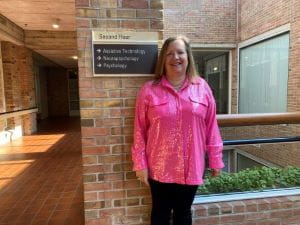
The chain of events seems unreal. Mindy, believing she had a bad case of COVID, had her husband rush her to Allina Health Mercy Hospital in Coon Rapids, Minn., on August 10, 2024.
She did not have COVID; she had a tear in her artery called an aortic dissection and needed open heart surgery to repair it. She suffered a series of strokes in the aftermath.
"It was a tough journey," said Dave, Mindy's husband of nearly three decades.
She was transferred to Allina Health Brain and Spine Institute at Abbott Northwestern Hospital in Minneapolis. The care team placed Mindy in a medically induced coma to allow her brain to rest. Life-support machines helped her breathe.
When it seemed like she was not making any progress, Mindy’s care team, husband, adult son, brother and father made the tough decision to turn off the machines.
Mindy kept breathing.
"My bestie says she didn't believe in miracles before, but she believes in them now,” Mindy said.
Courage on display
As Mindy continued to make progress, her care team moved her from comfort care to Courage Kenny’s acute inpatient rehabilitation at Abbott Northwestern Hospital and later, to the Transitional Rehabilitation Program at Allina Health Courage Kenny Rehabilitation Institute - Golden Valley.
The first 90 days of stroke recovery are critical; it’s when patients typically experience the most significant spontaneous gains. Additional intensive therapy during this time helps patients maximize their recovery.
Mindy had her work cut out for her, and her therapy team wasted no time getting her moving. Over the next three weeks, they helped her learn to eat, move around in a harness and wheelchair, walk and eventually climb stairs.
"Motor planning was very difficult for her," shared Taylor Mueller, OT, an occupational therapist with Courage Kenny who worked with Mindy.
Mindy powered through hours of daily speech, occupational and physical therapies. Mindy’s physical therapist helped her improve her mobility enough to walk, and Taylor prepared Mindy for the reason she was walking. They went over details and scenarios that most people take for granted.
"Why do you need to walk?” Taylor said. “Well, you need to go to the bathroom. OK, great. How will you manage that?”
Taylor taught Mindy to think about all the required steps. "You have to think about your balance for getting your pants up and down, getting yourself cleaned up, getting over to the sink and washing your hands."
There are many ups and downs in stroke recovery, according to Taylor. There can be days of strong progress and then what feels like a period when things seem to stall, but Mindy remembers the moment she recognized her hard work was paying off.
"It was a day when my bestie came and she couldn't believe that I was walking down the hall," recalled Mindy. "I was just walking down the hall with a walker, and she was like, 'Oh my gosh.'"
Finding support
Mindy's only goal was to get home and stay there. She did it, but her work toward recovery did not end.
Returning home for good can be tricky for stroke survivors as they try to put all they have learned into action. Mindy spent the first three months of her time home completing outpatient physical, occupational and speech-language therapies with Courage Kenny at Allina Health Mercy Hospital in Coon Rapids.
During that time of outpatient care, nurse care coordinators become part of a patient’s recovery journey.
"I contact stroke survivors right after they discharge home to see if they have questions or concerns about their recovery," shared Heather Odell, RN, BSN, an outpatient stroke rehab nurse care coordinator for Courage Kenny. "I make sure they're scheduled for all of the recommended appointments and offer mental health support and resources."
.jpg)
Heather also facilitates a support group for stroke survivors and their caregivers, which Mindy and Dave attend. They meet monthly, with additional outings, such as a recent get-together at a bowling alley. With the mission of connecting people and creating understanding, Heather guides conversations that address everything from gains to challenges, such as fatigue or handling comments like, “Why can't you return to work? You look fine."
"It's enlightening," said Dave. "I told Mindy it's not a minute that I don't learn something. Everybody's story is different, and everybody's type of stroke is different."
Mindy said she finds comfort in the way the group acknowledges caregivers. "The stroke impacts the caregivers as much as it impacts the stroke survivor.”
The journey continues
Mindy still has goals to reach for memory and movement, but she’s happy to be back to her favorite things, including traveling with Dave and their friends and cuddling her beloved dog, Fifi.
She’s also spreading the word about the importance of quick action in stroke emergencies. Her personalized BEEFAST license plate is a conversation starter about the acronym used for key signs of a stroke:
- Balance: Sudden loss of balance or coordination
- Eyes: Sudden blurred, double or loss of vision
- Face: Sudden drooping on one side of the face
- Arm: Sudden weakness or numbness in one arm
- Speech: Sudden difficulty speaking, slurred speech or trouble understanding words
- Time: If you notice any of these signs, call 911 immediately. Time is critical in treating a stroke.

Share this article


