Low-dose radiation offers relief for patients with joint and tendon pain
"I did my first round in October [2024], and I noticed relief pretty immediately," said Amy, a mother of four adult children who lived with pain in both her Achilles tendons for two decades.
Amy's story

Amy was the perfect candidate for low-dose radiation therapy – over 50 years old with no change in pain from standard treatments. Over the years, she said she tried a variety of methods to ease her extreme discomfort, including multiple rounds of physical therapy, dry needling, shockwave therapy, cryotherapy and platelet-rich plasma injections. None of them worked.
The pain from her tendonitis woke her up in the middle of the night. She gave up running and became resigned to tolerating the pain from her favorite activity, walking her dogs.
"[Walking] hurt quite a bit. The pain really reduced my quality of life. If I hadn't had pain, I would have walked a lot more," Amy added.
What is low-dose radiation therapy
A conversation between an oncologist and her mother led Amy to low-dose radiation therapy.
"My mom got lung cancer, and we started going to Dr. [Laura] Willson for radiation. Every time we saw her, she would assess my mom's pain levels," shared Amy. "My mom's complaint was never related to her lungs; it was always arthritis." Dr. Willson said, 'You know, in Europe they use low-dose radiation for arthritis. Maybe we can try it.'"
Amy jokingly asked if it could be used for tendonitis. It turns out that it can.
Low-dose radiation therapy uses about 1/20th of the radiation used in cancer care. The radiation oncologist targets the problem area to decrease inflammation by altering the inflammatory process at the cellular and molecular level to provide pain relief with minimal side effects. In Amy's case, it was her ankles (Achilles tendons). One round of low-dose radiation includes six sessions every other day over two to three weeks. Each session is about 15 minutes long. Extensive data from Europe suggests about 70-75% of patients with osteoarthritis conditions will have a positive response to low-dose radiation.
"I trust Dr. Willson a lot. I saw her so much with my mom. I think if it had not been her, I don't know if I would have agreed because radiation is intimidating," added Amy.
The results
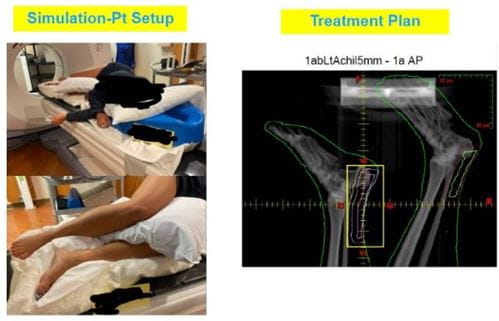
Since Amy, Dr. Willson has treated two dozen other patients with low-dose radiation for osteoarthritis and tendonitis based on recommendations from their orthopedic or sports medicine physicians. One patient thought they would have to travel to Germany to try the treatment. The doctor also described patients who could play the piano again or pick up a milk jug because their pain was no longer debilitating.
"I've gotten a note from one patient's orthopedic surgeon who told me the patient delayed her knee replacement surgery because the pain from her arthritis has decreased significantly. It's just amazing to see," added Dr. Willson.
Because the radiation dose is so low, there are no acute or major side effects. One study showed that out of 1,000 patients, only one reported mild skin redness.
"I feel like it's this untapped gem that could help so many people with little effort and no side effects," said Dr. Willson.
Share this article


